
A plan that’s ready to go – using mostly existing tracks, with partners at the table, and a term sheet that’s signed.
Roughly 190 miles from Fort Collins to Pueblo, with Denver Union Station at the center as the network’s hub.
Work, read, rest, or just arrive — get your time back instead of gripping the wheel on I-25.
Colorado Connector (CoCo) is an express intercity passenger train built for the Front Range. Powered by the Front Range Passenger Rail (FRPR) District, it will link 12 communities with fast, comfortable, relaxing service and it starts with tracks that already exist.
CoCo isn’t a someday idea. It’s a plan that’s ready to go. Colorado is showing the country how to fund and deliver passenger rail the right way: mostly existing tracks, partners who are already at the table, a term sheet that’s signed, and Starter Service that will be built via existing funding commitments. That means no new tax for this first phase.
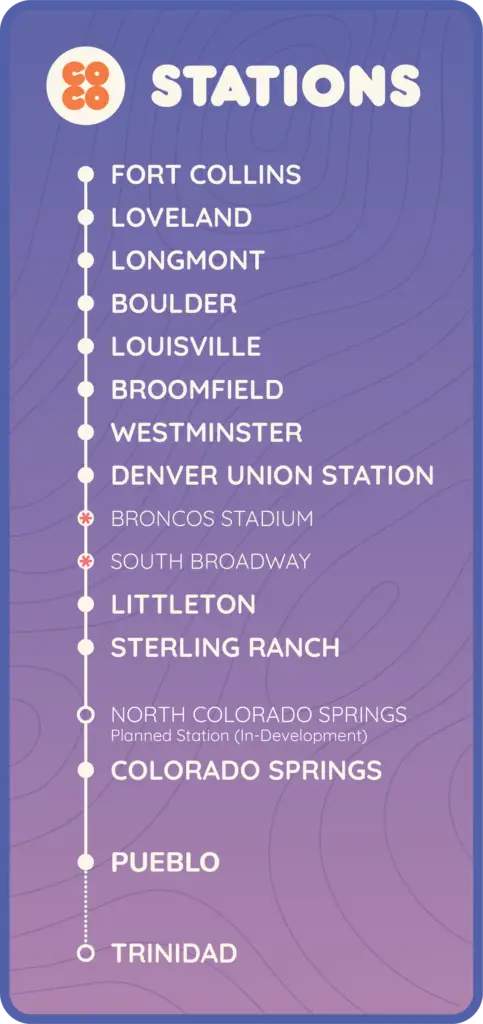
CoCo is defined by the places it connects: 12 Front Range communities. Its Core Segment runs roughly 190 miles between Fort Collins and Pueblo, with Denver Union Station at the center. These stops weren’t picked at random; they line up with where Coloradans already live, work, and travel.
We’d love to help! The most commonly asked questions are listed below. If you have additional curiosities, please view the FRPR District’s Delivery Plan here.
CoCo is a planned intercity passenger train for Colorado’s Front Range, powered by the Front Range Passenger Rail District (FRPR District) — the public agency the State created to plan, fund, and deliver it. It would connect 12 Front Range communities, with daily service at 12 stations between Fort Collins and Pueblo (plus new station infrastructure at Trinidad), all running on mostly existing freight tracks. Think comfortable, reliable, city-to-city travel with wider seats, room for luggage and bikes, food and beverage and more. It’s designed for longer trips than a typical commuter train, with Denver Union Station as the hub and is a practical alternative to driving I-25 and adjacent highways, built to get cars off the road and give riders their time back.
The Front Range is where Colorado lives and works — roughly 85% of the state’s population and 86% of its jobs — and it keeps growing. Travel on I-25, US 36 and US 287 has become slower and less predictable, and recent road investments haven’t kept pace with demand. CoCo helps get cars off the road and adds another way to make these trips: a reliable, comfortable option that lets people work, rest, or relax instead of fighting traffic. It also connects communities to jobs, education, healthcare, and events, while supporting each town’s own goals for the area around its station. Beyond being another travel choice, it offers environmental sustainability and opportunities to strengthen communities both experientially and economically.
The first phase, called Starter Service, is targeted to begin in 2029 with three daily round trips between Fort Collins and Denver, stopping at eight stations. From there, service grows in phases: extending south to Colorado Springs and Pueblo and adding more trips over a roughly 20-year horizon, toward a full build of up to 10 daily round trips in the north. Just as important, that first phase is being built via existing funding commitments and being implemented now. So this isn’t a distant someday project – the first trains are on a near-term timeline.
Yes — and much of the groundwork is already done. CoCo will start running on tracks that already exist, so there’s no need to carve a new route across the Front Range. Key partners are in place: the State and BNSF Railway signed a term sheet for a 25-year access agreement, Amtrak is the planned beginning operator, Union Pacific is a host railroad South of Denver, and RTD and CDOT are financial partners. Starter Service will be built via existing State and RTD funding commitments, so no new tax is required to begin in 2029. Full Service depends on new dedicated funding, which would come from a future ballot question in November 2026; this would be decided only by the communities closest to the permanent stations (they are the ones would be voting on it).
CoCo runs along roughly 190 miles of the Front Range between Fort Collins and Pueblo. The Core Segment follows two legacy rail rights-of-way that are bisected by Denver. First, the Front Range Subdivision, owned by the BNSF Railway (BNSF), extends north from Denver to Fort Collins. South of Denver, it follows the Consolidated Main Line and “Joint Line,” jointly owned by Union Pacific and BNSF, down through Colorado Springs to Pueblo. Daily service is planned at 12 stations: Fort Collins, Loveland, Longmont, Boulder, Louisville, Broomfield, Westminster, Denver Union Station, Littleton, Sterling Ranch, Colorado Springs, and Pueblo. Denver Union Station sits at the center as the network’s hub, connecting to RTD, Bustang, and Amtrak. Trinidad, another community, would get new station infrastructure on the existing Amtrak Southwest Chief. The District is also exploring special-event service to major venues down the line.
Town halls and public events held throughout the corridor, where you can hear directly from the team and share your perspective with local officials.
Record a video to share with your community and elected officials on why you are supporting CoCo.

Follow along and get updates along the way with explanations of how the project works, milestones, and more.
Be the first to hear exciting new updates about CoCo. Sign up for more information below:
Sharing Your Information
By submitting this form, you consent to the Front Range Passenger Rail District sharing your name and contact information with groups that request it. This may include committees formed related to Colorado Connector or other transportation initiatives.
Email & Text Communications
Front Range Passenger Rail District periodically sends email updates to anyone who submits this form. By unchecking this box, you will be opted out from email communications from Front Range Passenger Rail District and will not receive email updates.
By providing your mobile number, you consent to receive informational text messages from Front Range Passenger Rail. Message frequency may vary. Msg & Data rates may apply. Text STOP to opt out. Text HELP for help. For additional information, please see our Terms & Conditions.
Some big ideas never leave the page. CoCo is different. The FRPR District’s realistic approach leads the country on how to plan, fund and deliver a passenger train services within five years of receiving additional funding. So, yes, CoCo is Good to Go!
The State has signed a term sheet with BNSF for a 25-year access agreement to run passenger service between Denver and Fort Collins, with the formal agreement targeted for 2026.
Union Pacific will serve as the host railroad on the corridor south of Denver.
The planned starting operator, bringing crews, ticketing, maintenance, and federal safety compliance from a national platform
The state agency behind Colorado’s transportation network, CDOT, is a partner on technical expertise, delivery, and oversight.
Owner of the rail corridor between Westminster and Denver, and a core partner in launching the northern starter service.
On August 28, 2026, the Front Range Passenger Rail District (District) Board of Directors adopted Resolution 2026-32 approving the submission of a ballot question to the registered electors of the District at the November 3, 2026, General Election.
Colorado law requires the District to prepare an election notice, referred to as a TABOR Notice, for ballot questions that are subject to Article X, Section 20 of the Colorado Constitution (the Taxpayer’s Bill of Rights or TABOR) and to include that notice in the Blue Book that is mailed to Colorado voters. As part of that process, the District must provide members of the public with an opportunity to submit written comments both for and against the ballot question.
Interested parties are invited to submit written comments for or against the proposal to the District’s Designated Election Official. Comments can be submitted via email to [email protected], or in writing to the District’s principal office at 1800 W. 33rd Ave., Suite 200, Denver, CO 80211.
The District requests comments be submitted by 5:00pm MT on September 3, 2026, in order to meet Blue Book printing deadlines. Comments received after September 3, 2026, but prior to the constitutional deadline of September 18, 2026, will be summarized and made available on the District’s website.
The District’s proposed ballot question is available for review here: Resolution No. 2026-32 Adopting a Resolution to Submit a Ballot Question to the Registered Electors of the District at the November 2026 General Election.